
tgw and customer gateway
.png)
Hybrid Connectivity with AWS Transit Gateway and Customer Gateway
AWS cloud deployments often need to integrate seamlessly with on-premises data centers while still supporting rapid growth across many Virtual Private Clouds (VPCs). A powerful pattern for achieving this is the combination of an AWS Transit Gateway (TGW) on the AWS side and a Customer Gateway (CGW) on the on-premises side. This report dissects the technologies, shows a realistic end-to-end scenario, and presents an annotated architecture flow diagram. Every section is packed with implementation guidance, performance tuning tips, security safeguards, and operational best practices.
Overview
AWS Transit Gateway is a fully managed, highly scalable regional “cloud router” that interconnects VPCs, AWS accounts, Direct Connect links, and VPNs through a hub-and-spoke model, eliminating the complexity of a mesh of individual peering links. A Customer Gateway is the logical AWS resource that represents your physical or virtual edge device (router, firewall, SD-WAN box) and its public IP; it anchors the on-premises side of any Site-to-Site VPN or TGW Connect (GRE) tunnel. By combining TGW and CGW you can extend on-premises networks to hundreds of VPCs through a single, resilient, IPsec-encrypted attachment and let Border Gateway Protocol (BGP) dynamically propagate routes between environments.
Architecture Diagram
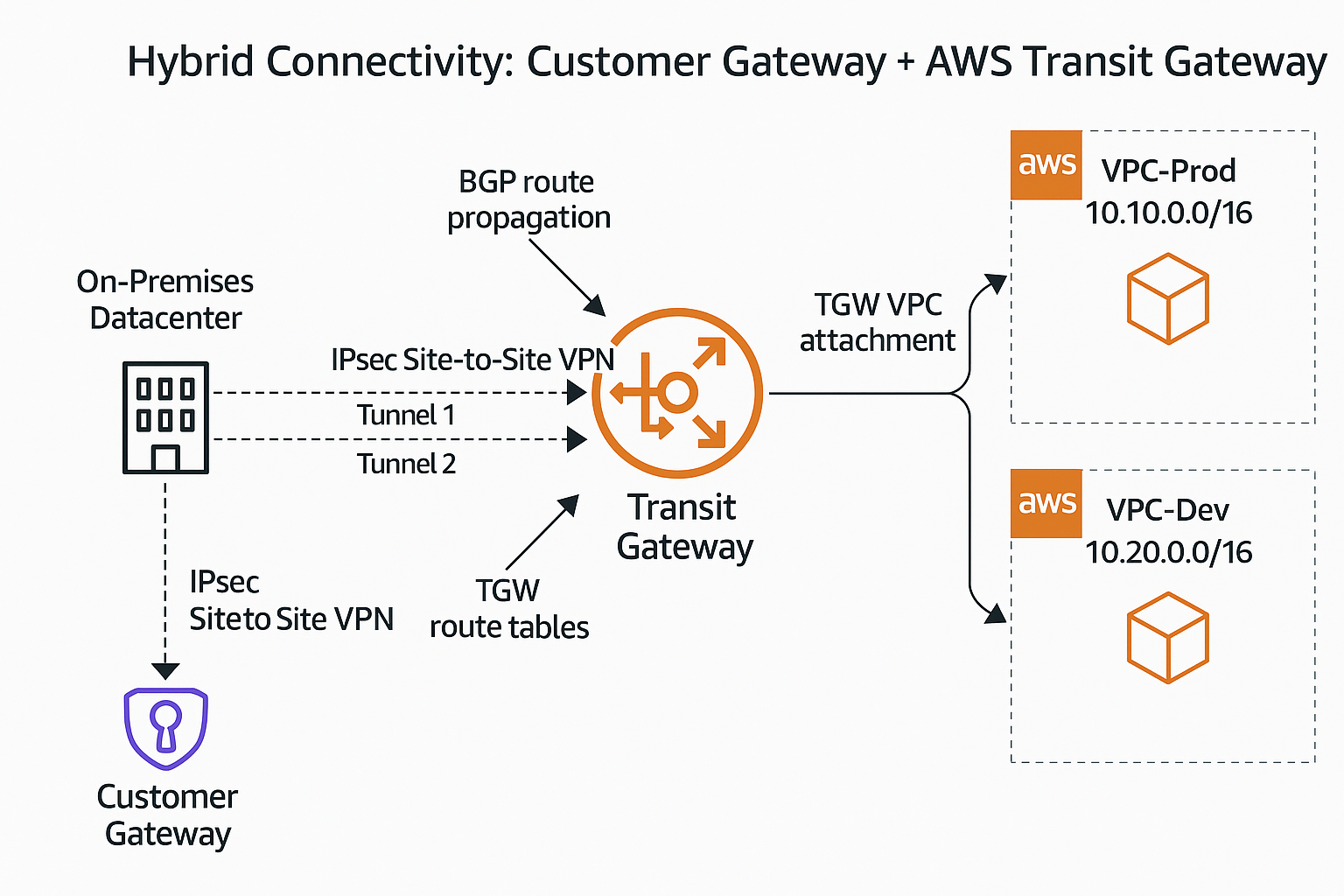
Figure 1: Hybrid connectivity architecture using a Customer Gateway and AWS Transit Gateway to link an on-premises network with multiple AWS VPCs
The diagram illustrates a hybrid hub-and-spoke topology:
Left: An on-premises data center router (the physical implementation of the CGW) advertises its internal CIDR 172.16.0.0/16.
Center: A regional AWS TGW terminates two redundant IPsec tunnels from the CGW, forms a BGP session, and shares routes.
Right: Two VPCs (Prod 10.10.0.0/16 and Dev 10.20.0.0/16) attach to the TGW. EC2 instances in each VPC automatically learn on-prem routes via TGW route propagation, while the on-prem router learns both VPC CIDRs via BGP.
TGW and CGW Fundamentals
What Is AWS Transit Gateway?
AWS Transit Gateway is a managed layer-3 router that:
Connects up to 5,000 VPCs per Region through simple “attachments,” replacing complex VPC peering meshes.
Supports VPC, VPN, Direct Connect, Transit Gateway Peering, and Connect (GRE) attachment types.
Offers up to 50Gbps aggregate throughput per attachment with Equal-Cost Multi-Path (ECMP) across up to eight tunnels, and up to 1.25Gbps per individual VPN tunnel.
Provides route tables to control traffic segmentation, enabling VRF-like isolation within a single TGW.
Delivers native high availability and automatic scaling without customer-managed appliances.
What Is a Customer Gateway?
A Customer Gateway is an AWS resource that stores metadata about your on-premises VPN endpoint:
ASN: The BGP Autonomous System Number used by the on-prem router for dynamic routing.
Public IP: A routable, static IPv4 or IPv6 address that terminates the VPN or GRE tunnels.
Device name & tags: Optional identifiers for maintenance and automation.
Connection type: Currently
ipsec.1for IPsec VPN orgrewhen deployed through TGW Connect.
Why Combine TGW and CGW?
Centralized routing
One gateway manages thousands of VPCs, cutting route table sprawl
Hub attaches VPCs & VPNs
Edge advertises on-prem prefixes
Dynamic scalability
Add/remove VPCs without touching on-prem configuration
Creates new VPC attachments
Unchanged
Security
IPsec tunnels provide encryption in transit by default
Terminates encrypted tunnels
Terminates encrypted tunnels
Resilience
Dual tunnels + AZ-agnostic TGW ensure failover under 30s
Maintains active-active HA
Runs redundant routers
Cost efficiency
Single VPN for all VPCs avoids per-VPC VPN fees
Shares connectivity
Shares bandwidth across spokes
End-to-End Use-Case Scenario
Business Context
A global retail enterprise runs legacy ERP and inventory services in an on-prem data center but hosts new microservices on AWS. Each application team owns its own VPC in a shared AWS Network account. The company must:
Provide bidirectional, low-latency, encrypted access between on-prem systems and cloud workloads.
Allow new VPCs to be onboarded weekly without changes to the on-prem firewall team.
Segment production and development traffic while still sharing the same TGW.
High-Level Design
Packet Flow Walkthrough
1
On-prem host 172.16.5.10 → Prod EC2 10.10.2.15
Packet routed to border router because 10.10.0.0/16 learned via eBGP
CGW
2
CGW → TGW
Packet enters IPsec tunnel 1, encrypted with AES-256-GCM
CGW → Tunnel
3
TGW decapsulates, consults tgw-rt-vpn
Sees 10.10.0.0/16 propagated by prod-attach
TGW
4
TGW re-encapsulates ENI header
Forwards to VPC ENI of prod-attach
TGW
5
Prod VPC route table
Local route delivers packet to EC2 in subnet
VPC
6
Return traffic
EC2 → TGW via local subnet route; TGW consults tgw-rt-prod, finds 172.16.0.0/16 propagated by VPN
EC2 → TGW
7
TGW encrypts into tunnel 2 (ECMP)
Traffic exits AWS, arrives in on-prem network
TGW → CGW
Throughput & Latency Expectations
IPsec tunnel (single)
1.25Gbps
≈50-100ms trans-continental (public Internet)
ECMP with 4 tunnels
5Gbps aggregate
Same as above, per-flow hashed
Direct Connect integration
50Gbps per VIF when using DX Gateway + TGW
2-20ms over private fiber
Cost Model
TGW data processing
$0.04/GB in us-east-1
1,000GB
$40.00
TGW VPN attachment
$0.05/hr
1
$36.00
VPC attachment
$0.05/hr
2
$72.00
IPsec data transfer
$0.09/GB (outbound) + $0.00 inbound
1,000GB
$90.00
Total
–
–
$238.00
Using Direct Connect (private VIF) can reduce per-GB egress to $0.02 and eliminate VPN attachment cost.
Best Practices Checklist
Dual tunnels, dual routers: Ensure each CGW device terminates separate tunnels for HA.
BGP keepalives: 10s/30s keepalive/hold timers strike balance between failover speed and stability.
ECMP: Enable ECMP on TGW and on-prem router to use both tunnels concurrently for load sharing.
VRF isolation: Use multiple TGW route tables to simulate VRFs and segregate prod, dev, and shared services.
CIDR management: Avoid overlapping CIDRs; TGW drops overlapping route propagations.
Automation: Leverage Infrastructure-as-Code and AWS Resource Access Manager (RAM) to share TGW across accounts.
Alternatives & When to Use Them
<10 VPCs, simple hub-and-spoke
Virtual Private Gateway (VGW)
Cheaper, simpler but no inter-VPC routing
Third-party NGFW inspection
Transit VPC with appliance
Layer-7 firewall, but higher cost & management
Global multi-Region SD-WAN
TGW Peering + Direct Connect
Private WAN over AWS backbone
Full mesh services only
AWS PrivateLink
No transitive routing; fine-grained service exposure
Conclusion
Pairing an AWS Transit Gateway with a Customer Gateway delivers a robust, scalable, and secure hybrid network foundation. The architecture grants enterprises a single ingress point to AWS, simplifies route management, and allows rapid onboarding of new VPCs—all without reconfiguring on-premises equipment. By following the implementation playbook and best practices outlined here, organizations can achieve high-performance, highly available connectivity that unlocks seamless workload portability between cloud and on-premises environments.