
site to site vpn connection
Site-to-Site VPN Explained
A site-to-site VPN securely links two private networks—typically a headquarters (HQ) LAN and a remote-branch LAN—so every device at either site can communicate as if they share one extended network. Instead of leasing dedicated circuits, the two sites use the public Internet but protect all traffic with an encrypted IPsec tunnel negotiated between their edge gateways.
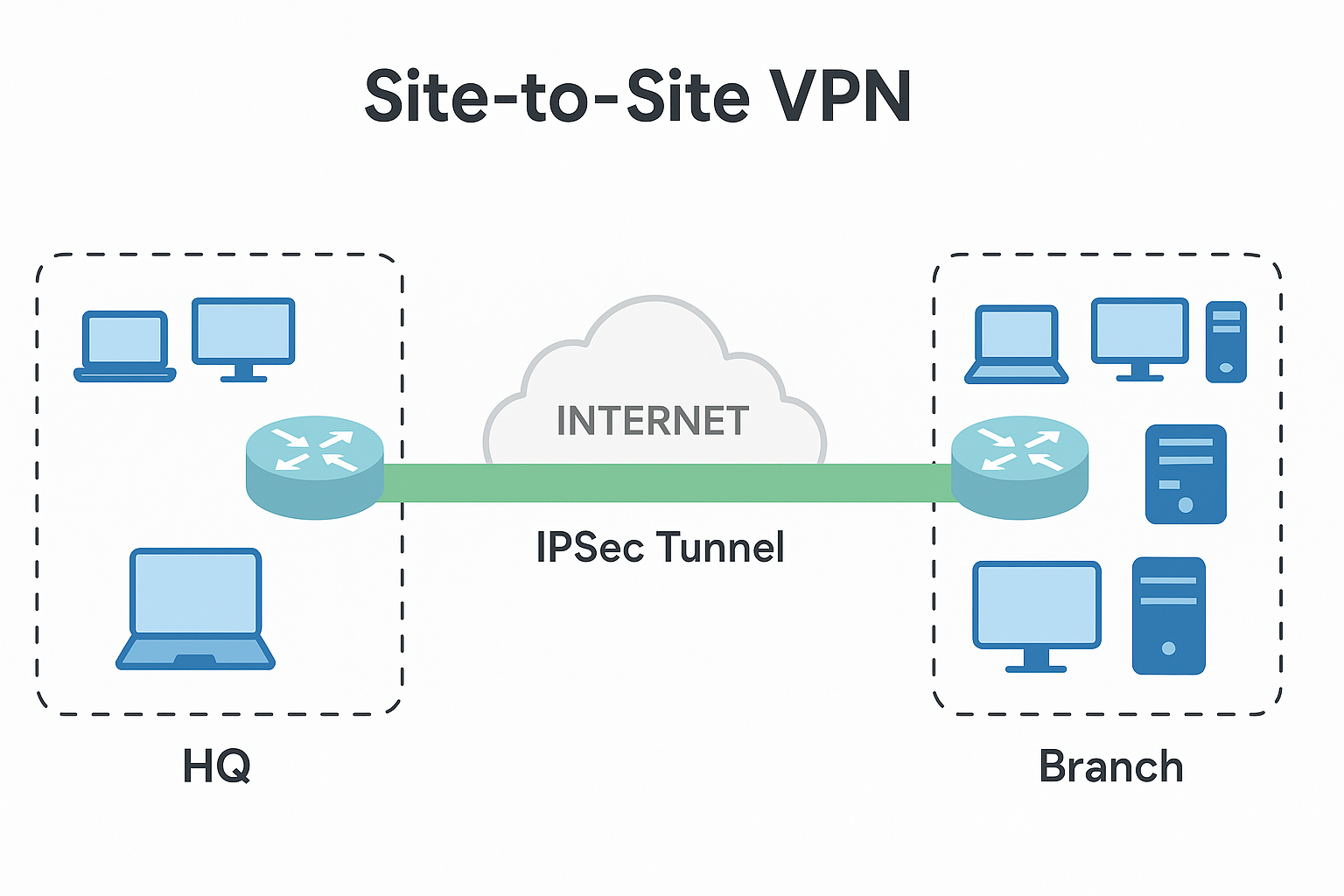
Site-to-Site VPN architecture: HQ and Branch connected with IPSec tunnel
Core Components
VPN Gateway
Performs encryption/decryption, builds the IPsec tunnel
Firewall, router, virtual appliance
Public WAN link
Carries the encrypted packets between gateways
Any ISP connection
Encryption & Authentication protocols
Provide confidentiality, integrity, entity authentication
IKEv2 for key exchange, AES-256/SHA-256 in IPsec phase 2
Internal routing
Moves decrypted packets inside each LAN
Static routes or dynamic (OSPF/BGP) advertised through the tunnel
How the Tunnel Forms (IKE/IPsec)
Real-Time Use Case: HQ ↔ Warehouse Inventory System
Scenario: A retailer’s HQ runs an ERP database (10.0.0.0/24). A new warehouse 500 km away needs real-time stock updates from barcode scanners on its LAN (10.1.0.0/24).
Benefits for students to note:
Security: Data is unreadable in transit; only vetted subnets pass through.
Cost efficiency: Uses inexpensive broadband instead of MPLS.
Transparency: End-devices need no VPN client; the network itself is extended.
Scalability: Additional branches can join via hub-and-spoke or full-mesh topologies using the same principles.
Key design tips:
Avoid overlapping IP ranges across sites.
Plan redundancy—dual tunnels or secondary gateways—to survive device/ISP failure.
Monitor SA lifetimes and tunnel health; enable alerts on re-key failures.
With this architecture and example, students can visualize how two distant LANs operate as one secure network without touching individual endpoints, a foundational concept for modern distributed enterprises.